
Lucerne history through surviving buildings
Lucerne history becomes tangible when the Water Tower, Reuss bridges, Jesuit Church and Lion Monument are considered as different historical layers. The city visible today includes old structures, a memorial to events elsewhere, a reconstructed bridge and a restored wall. Following these distinctions gives a visit a clear historical thread without needing to turn every square into a claim about the city’s beginnings.
Begin with the Water Tower, dated approximately from 1290 to 1300 and older than Chapel Bridge. Its relationship to the wooden crossing shows why a familiar city view can contain buildings from different moments. Then move through the dated examples below as a reading sequence, rather than a prescribed walking order. For a geographic itinerary, use the practical Old Town route; this page explains what changed and why those changes matter.
1408: a bridge named for the mills
The Spreuer Bridge lies downstream from Chapel Bridge and has a recorded construction date of 1408. Its name refers to chaff from the city mills that was thrown into the Reuss at this point. That connection gives the river crossing a meaning beyond its appearance: a place-name can retain a link to the working use of the river.
Compare it with Chapel Bridge as a separate structure with its own story. They both help you understand the Reuss as a thread through the city, but their histories should not be collapsed into a single date. When visiting, make the downstream crossing a point of comparison rather than assuming that everything seen at one bridge applies to the other. The Chapel Bridge guide considers the painting collection and later reconstruction in greater detail.
Explore with a local guide
A personalized visit with a local guide can help you orient yourself in Lucerne.
Hand-picked tours, booked through Viator. Prices are indicative starting prices in Swiss francs (as of October 2026). Tap a tour for live availability and the current price in your currency.
Discover the city with a local guide
A local city walk brings personal interpretation, travel tips and food recommendations to your exploration of Lucerne’s built heritage.
1666 and 1677: the Jesuit Church
Construction of the Jesuit Church began in 1666, and the church was consecrated in 1677. The baroque religious building stands beside the Reuss and also serves as a concert venue. These dates mark a different stage from the older tower and river crossings: the historical focus shifts from a bridge or tower to a church with continuing religious and cultural uses.
Read its place in the city from the riverbank before deciding on an interior visit. Worship, concerts and tourist sightseeing are different uses of the same building, so an open church is not an invitation to interrupt a service. The historical comparison works from outside as well: it places a baroque building beside the river infrastructure already encountered along the route.
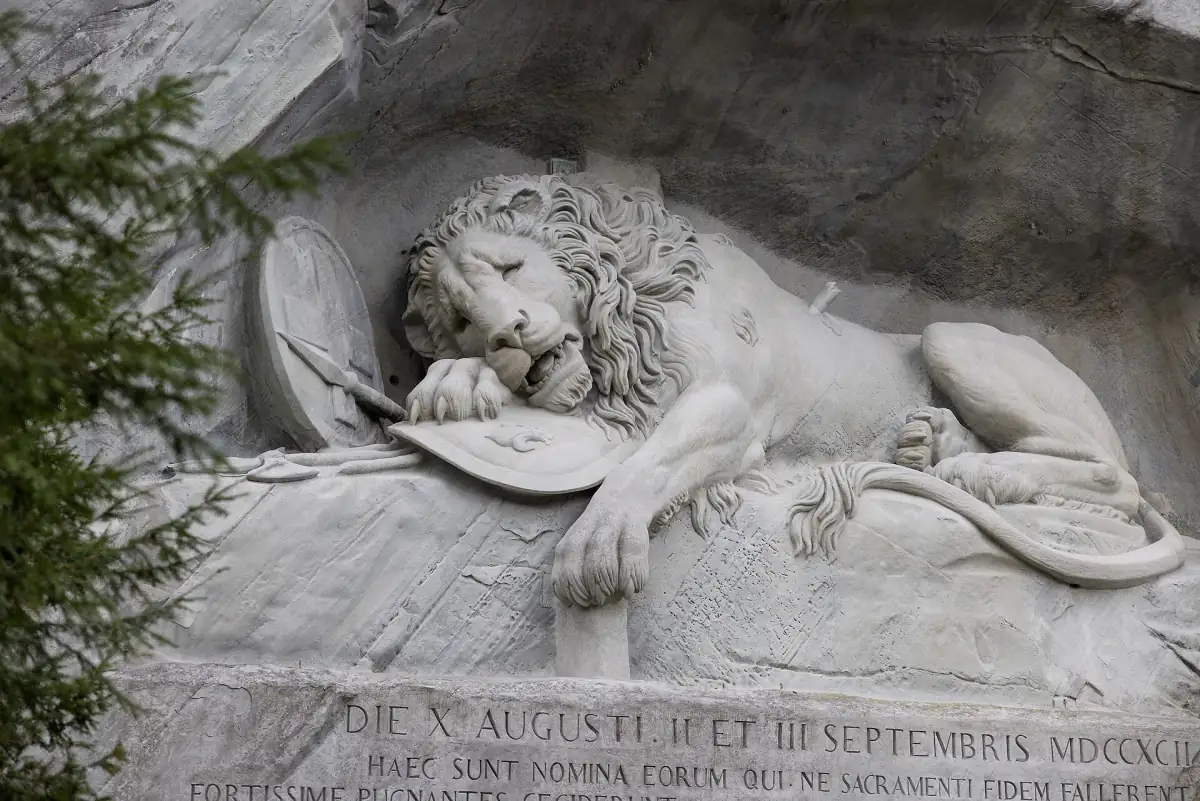
1792 remembered in the Lion Monument of 1821
The Lion Monument was inaugurated in 1821 to commemorate the Swiss Guards killed during the attack on the Tuileries in Paris in 1792. Bertel Thorvaldsen designed it. Keep the event and the inauguration separate: the monument is a later act of remembrance, not a structure dating from the event it recalls. This distinction explains how a memorial in Lucerne refers to history that unfolded in Paris.
The monument itself has free access. The neighbouring Glacier Garden is a separate museum visit, so looking at the memorial and buying a museum admission are distinct decisions. For a day that combines historical places with an exhibition, compare Lucerne museums rather than treating the neighbouring sites as a single ticketed attraction. Let the memorial’s subject set the pace of the stop before continuing your city visit.
1993 and 1994: destruction and reconstruction
Chapel Bridge burned during the night leading into 18 August 1993. The reconstructed part reopened on 14 April 1994, after about eight months. This episode is essential to understanding the present cityscape. The bridge is both a historic landmark and a place where reconstruction is part of the visible inheritance. Its familiar outline should not be mistaken for proof that the entire structure survived unchanged.
The paintings were also affected, so the fire belongs to the story of the building and its contents together. For the precise distinction between the original picture collection and the pictures on the bridge during the fire, turn to the bridge guide. Here the central historical lesson is that a city landmark can retain its place and identity while substantial parts of its material fabric have been replaced.
2007 to 2015: conserving the Musegg Wall
The Musegg Wall was restored from 2007 to 2015. About 870 metres of wall and nine towers survive. Restoration is another kind of change to distinguish from the bridge’s fire reconstruction and the Lion Monument’s commemorative purpose. Looking at all three helps explain why historic cities contain different forms of preservation rather than a single untouched past.
A local guided city walk offers another way to approach this built heritage. Its included services are a local guide, a personalised experience, travel tips and food recommendations. Recommendations are useful for planning a later meal; choose the walk for the local interpretation and city experience. Compare walking tours in Lucerne for other formats, and keep the wall’s seasonal access separate from the historical account.
Questions about your visit
What does the Lion Monument commemorate?
It recalls the Swiss Guards killed during the Tuileries attack in Paris in 1792. The monument itself was inaugurated in 1821 and was designed by Bertel Thorvaldsen.
Why does the 1994 reopening matter?
The reconstructed part of Chapel Bridge reopened on 14 April 1994 after the 1993 fire. The date explains why today’s landmark includes substantial reconstruction.
Can I visit the Musegg Wall throughout the year?
Regular public access is seasonal, from 1 April through 1 November, between 08:00 and 19:00. Snow can also interrupt access during the season; the historical restoration dates are not an opening calendar.